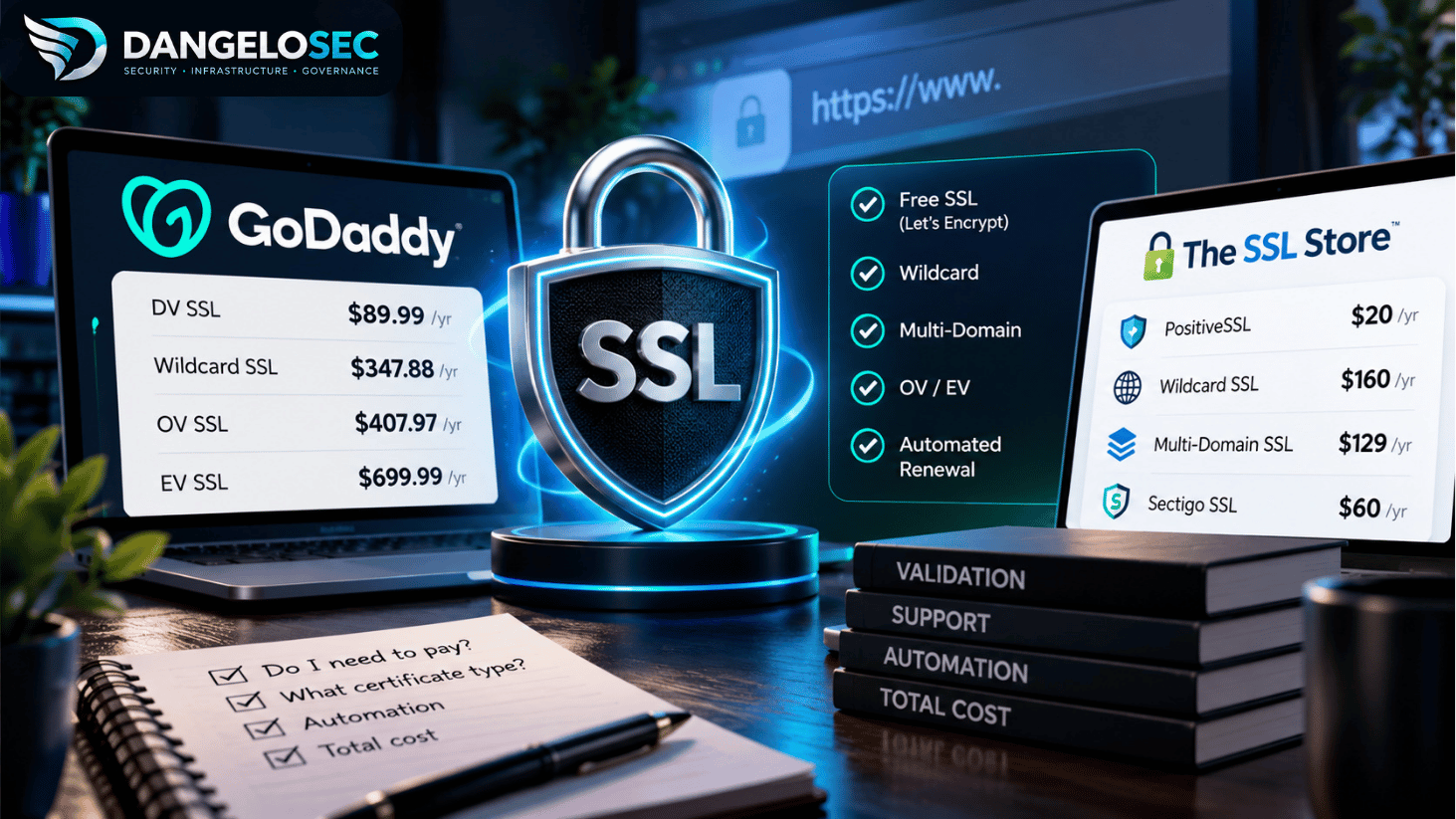
If you’re looking at the cost of a GoDaddy SSL certificate, there’s a more important question to answer first: do you actually need to pay for an SSL certificate?
For most standard websites, my answer is no.
If your hosting provider already includes an automatically renewed certificate from Let’s Encrypt or another trusted certificate authority, I would generally use that instead of buying a basic GoDaddy SSL certificate just to enable HTTPS.
That doesn’t mean paid SSL certificates are obsolete.
There are legitimate reasons to pay for one, including organizational validation, wildcard or multi-domain requirements, vendor support, certificate management, and environments where you want someone else responsible for installation and lifecycle management.
But paying for SSL doesn’t automatically give you “stronger encryption” than a properly configured free certificate.
And in 2026, there’s another factor that’s becoming increasingly important: certificates are getting shorter-lived.
The maximum validity for publicly trusted TLS certificates dropped to 200 days on March 15, 2026, with further reductions already scheduled under the CA/Browser Forum’s Ballot SC-081v3. That makes automation and certificate lifecycle management increasingly important when deciding what you’re actually paying for.
So before buying a GoDaddy SSL certificate, I would determine what problem I’m trying to solve.
Then I’d compare the available options.
GoDaddy SSL Certificate Cost: The Short Answer
GoDaddy doesn’t have one universal SSL certificate price.
The cost depends on the certificate type, validation level, automation, number of domains or subdomains, contract term, and whether you want GoDaddy to manage the certificate for you.
For example, GoDaddy currently advertises its manual Domain Validation (DV) wildcard certificate at $28.99 per month with a three-year term, while an automated version is advertised at $34.99 per month with a three-year term.
That’s roughly $347.88 and $419.88 per year respectively when expressed as an annual equivalent, although GoDaddy’s billing terms and renewal pricing should always be checked before purchasing.
GoDaddy also sells certificates with higher validation levels and managed options.
But price alone doesn’t tell you whether any of them are worth buying.
My recommendation
For a normal blog, portfolio, company website, or similar site that simply needs HTTPS: I would use an automatically renewed free DV certificate if my hosting provider supports it.
If I had a legitimate reason to purchase a commercial SSL certificate, I would compare certificate specialists before automatically buying from GoDaddy just because my domain happens to be registered there.
And if I were managing multiple domains, certificates, or servers, I’d pay particularly close attention to automation and lifecycle management.
That distinction is more useful than simply asking which SSL certificate is cheapest.
Why I Wouldn’t Pay GoDaddy Just for Basic HTTPS
SSL certificates have historically been marketed in ways that make the buying decision sound more complicated than it needs to be.
For a standard website, the fundamental requirement is straightforward: you need a valid TLS certificate so the browser and server can establish an encrypted HTTPS connection.
Let’s Encrypt provides these certificates for free. Its standard certificates currently have 90-day lifetimes, and the service is designed around automated issuance and renewal.
If my hosting provider already handles that process automatically, paying another company every year merely to get HTTPS would be difficult for me to justify.
Imagine a small company’s WordPress site. It has one domain, no unusual compliance requirement, no requirement for organizational validation, and a hosting platform that automatically issues and renews Let’s Encrypt certificates.
What business problem would a paid basic DV certificate solve?
If the answer is simply “it gives me HTTPS,” I wouldn’t buy it. The free certificate already solves that problem.
Does Paid SSL Provide Better Encryption Than Free SSL?
Not simply because it’s paid.
This distinction matters.
A paid DV certificate shouldn’t be presented as inherently providing stronger encryption merely because money changed hands.
The certificate helps authenticate the endpoint and establish the TLS connection. The security of that connection depends on factors including TLS configuration, protocols, cipher suites, certificate/key management, server configuration, and the client.
Price isn’t an encryption algorithm.
This is why I wouldn’t tell a business owner “buy GoDaddy SSL because paid SSL is more secure than Let’s Encrypt.” That’s too simplistic.
Instead, I’d ask whether the commercial certificate provides something the environment actually needs beyond basic domain validation and HTTPS.
That’s where paid SSL can become worthwhile.
What Are You Actually Paying for With a Commercial SSL Certificate?
Once basic encryption is separated from the purchasing decision, commercial certificates make more sense.
You may be paying for identity validation, support, warranty terms, certificate management, automation, wildcard or multi-domain configurations, or a commercial relationship with a certificate provider.
Those can all have value. But their value depends on the environment.
A solo blogger and an IT team managing certificates across multiple business systems don’t have the same requirements.
That’s why I wouldn’t make “free vs. paid SSL” a universal security decision. It’s an operational decision.
DV vs. OV vs. EV: What Changes When You Pay More?
One of the biggest sources of confusion around SSL certificate pricing is validation level.
| Certificate | What is validated | Typical use case |
|---|---|---|
| DV | Control of the domain | General websites and HTTPS |
| OV | Domain plus organizational identity | Businesses needing verified organization information |
| EV | More extensive organizational/legal identity verification | Organizations with specific identity-assurance requirements |
The important point is that moving from DV to OV or EV isn’t simply purchasing “more encryption.” You’re purchasing additional identity validation.
Domain Validation (DV)
DV is the simplest model. The certificate authority verifies that the requester controls the domain.
For many public websites, that’s sufficient. This is also why free services such as Let’s Encrypt can satisfy the HTTPS requirement for such a large portion of the web.
If all I need is encryption and domain validation, I would start there.
Organization Validation (OV)
OV goes further by validating information about the organization requesting the certificate.
That can matter when the certificate itself needs to carry validated organizational identity.
GoDaddy currently sells OV certificates and describes them as providing business identity verification in addition to domain ownership.
This is a legitimate reason to consider a commercial certificate. But I wouldn’t buy OV simply because someone told me it is “more secure” than DV. I’d buy it because I had a requirement for organizational validation.
Extended Validation (EV)
EV uses a more rigorous identity-validation process governed by CA/Browser Forum requirements.
Again, that’s about identity assurance. It’s not a magic switch that makes the encrypted connection inherently stronger than every properly configured DV connection.
And I wouldn’t justify EV using outdated marketing about dramatic browser address-bar treatment.
If my organization had a real requirement for EV validation, I’d evaluate it. Otherwise, I wouldn’t pay extra merely because “Extended Validation” sounds safer.
What About GoDaddy Wildcard SSL?
Wildcard certificates are one of the more interesting paid SSL use cases.
Instead of protecting only one hostname, a wildcard certificate can cover multiple subdomains under the same base domain. For example: www.example.com, shop.example.com, portal.example.com, support.example.com.
That can simplify certificate management in some environments.
GoDaddy currently advertises its manual Wildcard DV certificate at $28.99/month on a three-year term, while its automated option is advertised at $34.99/month on a three-year term.
| GoDaddy Wildcard option | Advertised monthly equivalent | Approx. annual equivalent |
|---|---|---|
| Manual DV Wildcard | $28.99 | $347.88 |
| Automated DV Wildcard | $34.99 | $419.88 |
At that price level, I would absolutely compare alternatives before buying.
For example, The SSL Store currently lists PositiveSSL Wildcard DV at $160 for a one-year term, with lower annualized pricing advertised for longer terms.
Its Sectigo certificate catalog also lists commercial wildcard alternatives.
That doesn’t automatically make one provider better. Support, certificate brand, validation, management tools, automation, contract terms, renewal pricing, and the exact product all matter.
But it demonstrates why I wouldn’t automatically purchase SSL from my domain registrar.
Need a paid SSL certificate? Compare current DV, wildcard, multi-domain, OV, and EV certificate options before buying.
Compare SSL Certificates at The SSL Store →
Do You Need to Pay for a Wildcard Certificate?
Not necessarily.
This is another area where paid SSL marketing can oversimplify the decision.
Let’s Encrypt supports wildcard certificates using the DNS-01 challenge.
So the logic shouldn’t be “need wildcard → must buy SSL.”
The better question is: can my infrastructure automate the wildcard certificate I need?
If my DNS and hosting environment support automated Let’s Encrypt wildcard issuance and renewal reliably, I’d consider that before purchasing a commercial wildcard certificate.
If they don’t — or if I need vendor support, organizational validation, centralized management, or another commercial requirement — paying may make sense.
Again, the certificate isn’t the whole product. Operations matter.
Wildcard vs. Multi-Domain SSL: Don’t Buy the Wrong Certificate
Wildcard and multi-domain certificates solve different problems.
A wildcard certificate generally protects multiple subdomains under a domain. For example: app.example.com, shop.example.com, mail.example.com.
A multi-domain or SAN certificate can protect multiple different hostnames or domains in one certificate. For example: example.com, example.net, company.org, mail.company.com.
That distinction matters in business infrastructure.
If I’m protecting many subdomains beneath the same domain, wildcard may be appropriate. If I’m consolidating several different domains or hostnames, I would investigate a multi-domain/SAN certificate instead.
GoDaddy itself points customers toward UCC/SAN certificates for certain environments rather than treating wildcard as the universal answer.
The SSL Store also sells multi-domain products, including Sectigo Multi-Domain/UCC certificates.
This is another reason I’d define the architecture before choosing the certificate.
The Biggest SSL Change in 2026 Isn’t the Price
This is the part I’d pay the most attention to if I were responsible for certificates in a business environment.
On March 15, 2026, the maximum validity period for publicly trusted TLS certificates dropped to 200 days.
And that’s only the beginning.
The approved schedule reduces maximum certificate lifetimes further:
| Effective date | Maximum TLS certificate validity |
|---|---|
| March 15, 2026 | 200 days |
| March 15, 2027 | 100 days |
| March 15, 2029 | 47 days |
These requirements come from the CA/Browser Forum’s Baseline Requirements for publicly trusted TLS certificates.
Think about what 47-day certificates mean operationally.
Manual renewal once a year is one thing. Repeated certificate replacement across dozens of systems is something else entirely.
This is why I believe the SSL purchasing conversation is changing.
The certificate itself is becoming shorter-lived. The real product you’re increasingly paying for is certificate lifecycle management.
Automation Matters More Than Ever
Shorter certificate lifetimes aren’t inherently a problem when renewal is properly automated.
That’s the important part.
Let’s Encrypt was built around automated certificate issuance and renewal, and it has already published plans around progressively shorter certificate lifetimes as the ecosystem moves toward the 2029 requirements.
GoDaddy is also adapting. It now distinguishes between manual and automated certificate offerings, including automated reinstallation using ACME-based certificate management.
That changes what I’d evaluate before purchasing.
Five years ago, someone might have primarily asked: how much does the certificate cost per year?
Increasingly, I’d ask: how will this certificate be issued, renewed, deployed, monitored, and replaced without someone manually touching the server every few weeks?
That’s the IT infrastructure question.
Manual SSL Is Becoming Harder to Justify
This doesn’t mean manual certificate management disappears overnight.
Legacy systems exist. Appliances exist. Internal processes exist. Unsupported platforms exist.
There will be environments where automation isn’t straightforward.
But as certificate lifetimes fall from 200 days to 100 and eventually 47, every manual process becomes more expensive operationally.
Imagine managing 30 certificates. If renewal requires a technician to generate a CSR, complete validation, download the certificate, install it, verify the chain, restart services, and confirm application health each time, the certificate’s purchase price may become the least important cost.
The labor is the cost. And the risk of missing one renewal is another cost.
That’s why I’d prioritize automation over small differences in certificate price for any environment with more than a handful of certificates — the same ownership and process question that shows up whenever a manual task quietly becomes a business risk nobody assigned to anyone.
GoDaddy Automated SSL vs. Manual SSL
This is one area where GoDaddy’s more expensive option has a rational value proposition.
You’re not necessarily paying for “better encryption.” You’re paying to reduce certificate-management work.
GoDaddy’s current automated certificate offering is designed to automatically reinstall certificates as required rather than requiring the customer to repeatedly handle that process manually.
If I had an environment where that automation worked reliably and saved meaningful administrative effort, I could justify paying more for it.
But I’d still compare it with automated certificates already included by my hosting provider, Let’s Encrypt with ACME automation, certificate management available through my CDN/cloud platform, other commercial certificate providers, and centralized certificate lifecycle management where appropriate.
The right answer depends on the infrastructure.
The wrong answer is buying a certificate first and figuring out operations afterward.
Is GoDaddy SSL Worth It for a Small Business?
For a typical small-business website? Usually not if the only requirement is HTTPS and the hosting provider already includes automated SSL.
That’s the scenario where I’d use the free certificate.
But imagine a different small business. It has no technical administrator. Its certificate isn’t managed by the hosting platform. The owner doesn’t want to troubleshoot validation failures, private keys, intermediate certificates, web server configuration, or renewals.
Now support and managed installation have value.
Paying someone to take responsibility for an operational task you don’t have the expertise or time to manage can be perfectly reasonable.
So I wouldn’t say “paid SSL is a waste of money.” I’d say: don’t pay for SSL until you know what you’re paying to solve.
Is GoDaddy SSL Worth It for Ecommerce?
Ecommerce doesn’t automatically mean you need to purchase a GoDaddy certificate.
A properly configured free certificate can still provide the HTTPS connection required for an ecommerce website.
The fact that customers enter payment information doesn’t automatically transform paid DV into stronger encryption.
There may, however, be other requirements around your ecommerce architecture, payment processor, organization, compliance environment, support expectations, or certificate management.
Those requirements should determine the certificate decision. Not fear-based marketing.
For many modern managed ecommerce platforms, SSL is already integrated into the service. In that case, I’d use the platform’s supported certificate architecture rather than adding another certificate simply because it’s commercially available.
Does Buying GoDaddy SSL Improve SEO?
I wouldn’t buy it for that reason.
HTTPS has long been part of Google’s web ecosystem and is a baseline expectation for modern sites.
But that does not mean purchasing a paid GoDaddy certificate gives you an SEO advantage over a valid free certificate providing HTTPS.
GoDaddy currently references search visibility among the benefits of SSL on its marketing pages.
That should not be interpreted as “paid GoDaddy SSL ranks better than Let’s Encrypt.”
If both sites are correctly using HTTPS, I wouldn’t choose between the certificates based on SEO.
Choose based on security architecture, validation, support, automation, and operational requirements instead.
GoDaddy SSL vs. The SSL Store: Which Would I Choose?
I wouldn’t choose purely by company name.
I’d first decide whether I needed a commercial certificate at all.
If the answer were no, I’d use automated free SSL.
If the answer were yes, I’d compare the exact certificate requirements and total cost.
The SSL Store is particularly useful as a comparison point because it distributes certificates from multiple certificate authorities rather than tying the purchasing decision to the company where the domain happens to be registered.
Current offerings include certificates from providers such as Sectigo and DigiCert across DV, OV, EV, wildcard, and multi-domain categories.
That gives me more options to compare.
For example, if I had already determined that I needed a paid wildcard certificate, seeing a PositiveSSL Wildcard option advertised substantially below GoDaddy’s current wildcard pricing would be enough for me to investigate further before checking out at GoDaddy.
It doesn’t automatically mean I’d buy the cheapest certificate. But I definitely wouldn’t buy from the registrar without comparing.
If you already know you need a commercial certificate, compare the certificate rather than the registrar.
Compare SSL Certificate Options at The SSL Store →
When I Would Pay for SSL
I would consider a commercial certificate when there is a specific operational or business requirement behind the purchase.
Examples include an actual need for OV or EV identity validation, commercial support, centralized certificate management, specific wildcard or multi-domain requirements, compatibility requirements, or an environment where a managed certificate service reduces meaningful operational risk.
I would also pay when the cost of managing the certificate myself is greater than the cost of having someone else handle it.
That’s an IT decision rather than a marketing decision.
When I Would Not Pay for SSL
I would not purchase a commercial certificate merely because “websites need SSL.”
That’s true in the practical sense that modern public websites should use HTTPS. But it doesn’t follow that websites need paid SSL.
If I had a standard website and my host already provided automated Let’s Encrypt certificates, I’d use them.
I also wouldn’t pay more because I had been told: paid certificates automatically use stronger encryption; ecommerce inherently requires paid SSL; a paid certificate automatically improves Google rankings; wildcard certificates always have to be purchased.
Those claims either oversimplify the technology or confuse a particular requirement with the certificate’s price.
How I’d Choose an SSL Certificate in 2026
If I were responsible for the decision, I’d use this order:
1. Determine whether I need a commercial certificate at all. If free automated DV meets the requirement, stop there.
2. Determine the validation requirement. Do I need DV, OV, or EV? Don’t pay for organizational validation unless there is a reason to have it.
3. Map the domains. One hostname? Multiple subdomains? Multiple unrelated domains? That determines whether standard, wildcard, or SAN/multi-domain architecture makes sense.
4. Determine how renewal will work. This is becoming critical. A certificate management process that depends on someone remembering a calendar notification is increasingly difficult to defend as lifetimes shrink.
5. Compare support and management. Who owns the problem when validation fails or a certificate doesn’t deploy correctly?
6. Only then compare prices. By this point you’re comparing products that actually solve the same problem. That’s when price becomes useful.
Frequently Asked Questions
How much does a GoDaddy SSL certificate cost?
GoDaddy SSL pricing depends on certificate type, validation, automation, contract length, and management level. For example, its current U.S. Wildcard DV offering advertises a manual option at $28.99/month and an automated option at $34.99/month on three-year terms.
Always verify checkout and renewal pricing before purchasing because promotions and terms can change.
Does GoDaddy offer free SSL?
Some GoDaddy hosting products may include SSL as part of the hosting service, so the answer depends on the product you’re already using.
Before purchasing a separate certificate, check what your hosting plan already includes. Buying another certificate when automated SSL is already included would solve a problem you don’t have.
Is free SSL as secure as paid SSL?
For the basic purpose of establishing a properly configured encrypted HTTPS connection, a free DV certificate isn’t inherently weak because it is free.
Commercial certificates can add organizational validation, support, warranties, management, and other services. Those differences may matter, but price itself doesn’t make TLS encryption stronger.
Is Let’s Encrypt better than GoDaddy SSL?
For a standard website that only needs automated DV and HTTPS, I’d generally choose Let’s Encrypt if the hosting environment supports it reliably.
For an organization needing commercial support, OV/EV validation, specialized certificate products, or managed certificate operations, a commercial provider may be more appropriate.
Is GoDaddy SSL worth the price?
For basic HTTPS when free automated SSL is already available, I don’t think it is. For a specific commercial requirement or managed service need, it may be.
The deciding question is what additional problem the paid certificate solves.
Can I use free SSL for ecommerce?
Yes, provided the certificate and overall TLS configuration meet the requirements of the ecommerce platform and surrounding environment.
Ecommerce by itself does not mean the certificate must be paid.
Do I need OV or EV for a business website?
Not automatically. A normal business website can use DV. OV and EV become relevant when verified organizational identity is an actual requirement.
Should I buy SSL from the same company where I bought my domain?
There’s no general technical requirement to do so. Domain registration and certificate issuance are separate services.
If you need a commercial certificate, I would compare certificate products, support, management, renewal terms, and pricing rather than automatically buying from the registrar.
GoDaddy SSL Certificate Cost: My Recommendation
If all you need is HTTPS for a normal website, I would not pay GoDaddy for an SSL certificate when reliable, automated free SSL is already available through your hosting environment.
Use the free certificate and make sure renewal is automated.
If you genuinely need a commercial certificate, don’t automatically buy it from GoDaddy because that’s where your domain is registered. Define the requirement first.
Do you need organizational validation? A wildcard? Multiple domains? Commercial support? Managed installation? Certificate lifecycle automation?
Once you know that, compare providers and total cost.
And in 2026, I’d put increasing weight on that last operational question.
Certificate lifetimes are already down to 200 days and are scheduled to reach 100 days in 2027 and 47 days in 2029.
That means the old model of purchasing a certificate and manually thinking about it once a year is disappearing.
For basic HTTPS: use automated free SSL.
For a legitimate commercial certificate requirement: compare providers before buying from GoDaddy.
For business infrastructure at scale: prioritize automation and lifecycle management, not just certificate price.
That’s where I’d spend the money.